
CAMP JOFFRE…..so handy for the railway
Camp Joffre opened in 1938 and closed in 1970. Its history is horrific. In that first year it changed in the blink of an eye from housing for the troops to housing for “Undesirables”. Soon refugees from the Spanish Civil War, Jews and Gipsies joined the “Undesirables”. So handy for the railway. Destination: Auschwitz, via Drancy.
The sad history of Camp Joffre
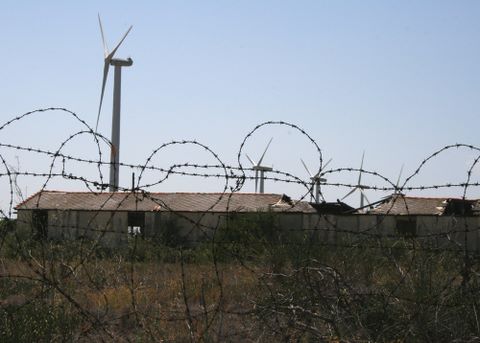
Camp Joffre, internment camp in Rivesaltes from 1938 – 1970 has been turned into a memorial museum. It was named after general Joseph Joffre, commander-in-chief of the French Army during WW1,
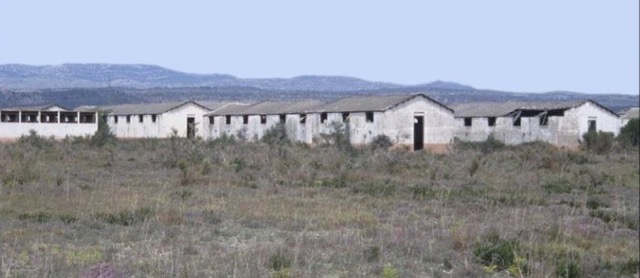
In 1935, the commune of Rivesaltes, situated on a rail route and 40 km from the Spanish border, was considered a strategic position. Five km from Rivesaltes, the army, who occupied 612 hectares between Rivesaltes and Salses, constructed a military base, to train troops to adapt to warm climates, in case of deployment abroad.
In 1939, at the start of WW2, the camp became a military transit base and in 1940, was used to shelter the thousands of Spanish refugees fleeing the Franco dictatorship, a slightly better alternative to the freezing beaches of Argèlès and Le Barcarès, on which so many of these unfortunate Republicans had been interned as ‘foreign undesirables’.
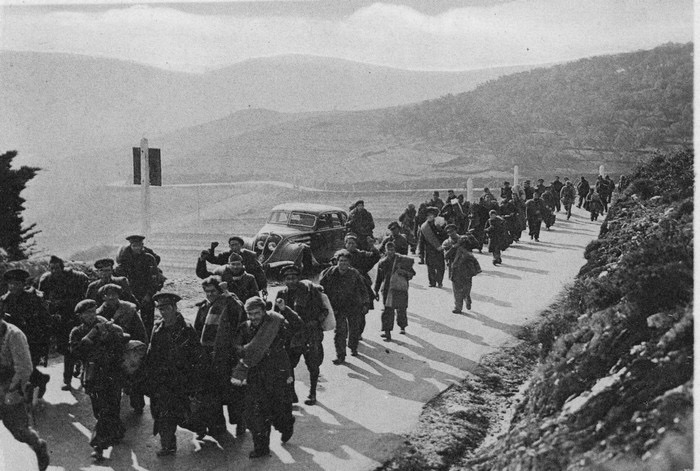
After the signing of the armistice, France was split into two and the « zone libre » in which the Pyrenees-Orientales was included, came under the administration of the Vichy government, a close ally of Germany.
In January 1941, the Vichy regime opened the ‘Centre d’Hébergement de Rivesaltes’ (Rivesaltes Accommodation Centre) on the camp premises for interning ‘Sinti and Roma’, (Gypsies) political opponents and Jews. It was at this point that the sad and sinister history of the camp Joffre began to unfold.
With a capacity of 8000, it was not long before the camp was overcrowded, families were separated, and conditions deteriorated enormously.
In 1942, under German pressure, the camp became a ‘Centre national de rassemblement des Israélites’ – a ‘sorting centre’ for Jews who were then sent on to the death camps such as Auschwitz, via Drancy. Two thousand five hundred and fifty one Jews are recorded as having been deported from Rivesaltes – four hundred of them were children.
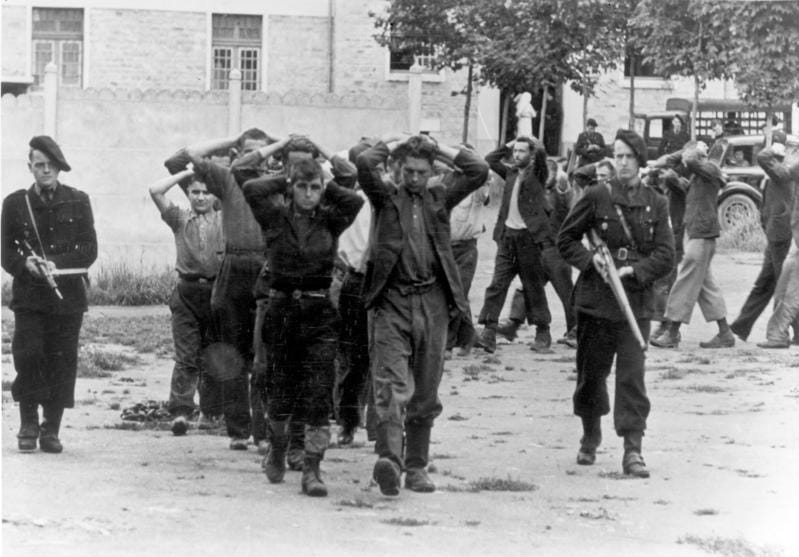
In 1942, when the Germans occupied the ‘zone libre’ they closed the camp, but when the south of France was liberated in 1944, Rivesaltes was reopened until 1948 for collaborators and traitors, and in 1945 housed German soldiers and prisoners of war.
And why stop there? In 1962 it once again became a ghetto. This time for the hundreds of thousands of Algerians or ‘harkis’ who left Algeria at the time of the battle for its independence from France. Many of these families did not leave the camp until its closure in the late sixties.
The camp retained a military presence, despite the fact that much of it is in ruins, until quite recently, being used to detain ‘étrangers en situation irrégulière’ (illegal immigrants etc)
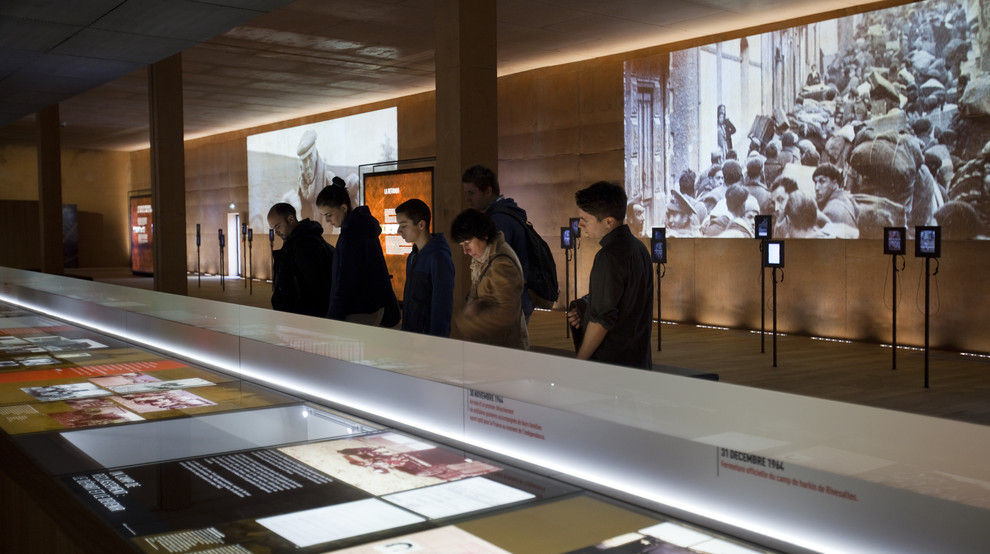
Before the building of the museum which now stands there the moving panel at the entrance asked the question: How long have these ruined barracks, this barbed wire been here? And for how long will they remain to remind us of the blackest years of the XX Century? The Conseil General’s decided to preserve the remains as a memorial, to prick the public conscience, to remind us “DE NE PAS OUBLIER” (never to forget)
Friedel Bohny-Reiter worked for the Swiss Red Cross in the barracks during the war. You can read more about her in our article: Friedel Bohny-Reiter and the K12 Barrack.
FIND OUT MORE ABOUT THE MEMORIAL MUSEUM
L.EST WE FORGET
Taken from the Jewish Virtual LibraryRIVESALTES, created last January, is a detention camp for families and children; it holds 8,000 internees, 3,000 of whom are children. There are 3,000 Jews there, whose situation is no better than those living at Gurs. The camps of NOE and RECEBEDOU, which are practically identical in their composition and number of inmates, each hold 1,700 – 1,800 sick, old and infirm internees. The composition of the MILLES camp is variable: it detains persons scheduled for emigration. On March 22, it had 1,000 inmates, of whom 80 were Jews. The Internment Camps At VERNET, there are 3,200 interned men, of whom 25% are Jews, political prisoners and refugees with a more or less regular administrative situation. The ARGELES camp holds 200 Jews together with 700 Spanish cripples. The RIEUCROS camp is the womens equivalent of VERNET; it holds 400 undesirable Jewish women. The living quarters in most of the camps consist of badly constructed huts, susceptible to wind, rain, and cold. In almost all the camps, windows are replaced by full awnings, which have to be lifted up to let a little air in. These huts are 50 to 60 meters long and shelter up to 96 people in two tiers. The internees sleep on straw, except for those who have been able to purchase a straw mattress. The straw is very rarely changed. The quarters, in general, are very badly maintained and, with only rare exceptions, are repugnantly filthy. It is impossible to get rid of the vermin that have taken hold there, since there does not exist in any camp a systematic disinfecting mechanism. In general, the internees possess only the garment and the underwear that they wear, and the hovels in which they live makes it impossible from them to properly look after their clothing. Furthermore, there are not enough washbasins, the water supply is often insufficient, and showers are too rare. Thus, for months, the internees have only been able to wash themselves hastily and incompletely. Some have not undressed for six months. One can imagine their present state of destitution. Access to lavatories is generally difficult because of the mud surrounding them. Almost everywhere they are so poorly maintained and so rarely disinfected that not only is there a dreadful stink but also a permanent risk of infection, especially during the hot season when flies and mosquitoes proliferate and spread contagious diseases. Rodents have appeared, which besides attacking the food reserves, also carry harmful bacteria. In addition to the poor accommodation, the wretched internees in most of the camps are also poorly fed. The food allowance allocated to them is a daily 10 francs 50. In principle, this is sufficient to provide for a normal diet. The allowance, however, is never completely spent on food because of various reasons, in particular, the current difficulty in procuring food. The amount spent daily by each internee has been evaluated at 3-4 francs. While the normal ration required by a human being lies between 2,000 and 2,400 calories – the essential requirement being 1500 calories – most of the internees consume barely 800 calories. In addition, the cold in their living quarters and their inadequate clothing cause an abnormal calorie loss. An example of a daily ration distributed in a camp best illustrates the gravity of the situation: 180 to 200 grams of bread. The children at RIVESALTES, for instance, receive milk coffee without bread in the morning; from six o’clock in the evening until the following day at noon, they remain without a gram of solid food. In truth, in certain camps the food is distributed less sparingly, but the above example is the most common diet in most of the camps. The consequences of living in unhealthy living quarters with an almost total lack of hygiene and a seriously unhealthy diet have very rapidly manifested themselves. The situation of the children is particularly wretched. Over 20% of the children are nervy or weak and should urgently be removed from the camps. The health of most of the adult internees is also very deficient. A substantial rise in tuberculosis claims new casualties daily. A progressive weakening of the body, which occurs in all the internees (many of whom had already arrived at the camp in a pitiful physical state), leaves the door open to illness. At the St. Cyprien camp, which has now been closed, 85% of the internees simultaneously fell victim to dysentery; at Rivesaltes, 80% of the internees suffer from chronic enteritis. Such occurrences are far too numerous. Despite all these diseases, which grow in scope monthly, hospitalization is very rare and insufficient. A painful example is that of the St. Louis Hospital in Perpignan, which although it resembles the worst medieval general hospitals, it continues to receive patients. Not all the hospitals are as badly equipped, but, unfortunately, even when there are doctors and beds for the patients, there is no medication, no basic sanitary material, and no artificial limbs. Such material conditions unavoidably have a lamentable effect on morale. The material destitution of the wretched internees in these camps results in a parallel moral destitution. The problem is multi-faceted. Except for the RIVESALTES camp, which accommodates whole families, households have been split up, and there are only a few makeshift households … Parental authority has been made impossible and education impracticable. Thus, unfortunate people, who have undergone appalling trials, lead an atrociously difficult daily life. Releases being so rare, they cannot even take comfort in the hope of a better future. The comfort that many of them seek in practicing their religion is rarely permitted. In several camps, morale has been severely affected by the measures recently taken by the German authorities, who periodically conscript workers in the camps. At Argeles, 130 Jews of all nationalities aged 15 to 65 have been embarked for an unknown destination; at Rivesaltes, 50 people have undergone the same fate. Other departures are scheduled, causing great consternation in the wives and children of those who might be taken. Thus, both the material situation of the internees and the state of their morale are tragic. If we are to prevent the internees from sinking into disease and death or into discouragement and despair, we must act very rapidly and efficiently. |
[/vc_column_text][/vc_column][/vc_row]
[…] Rivesaltes Internment Camp – Camp Joffre – anglophone-direct […]