Tourist Info > Did you know P-O.....?
Did you know.... France
 Articles in
this section :
Hunting for Treasure in the Pyrenees-Orientales
An exclusively Catalan frog? Well, not (...)
’Bal-musette’ You are very (...)
Canigou and Kipling In a letter to M. (...)
Castells and castellers (...)
Catalan donkey symbol You may already (...)
Cheeky Monkies.... The Simiots of Arles-sur-Tech
Correfocs Correfocs originate from a form (...)
Do you live near a prat? Well, best not to (...)
Don’t shoot! It’s a rifle! (...)
Catalan National Anthem Els Segadors (...)
The start of WW3? Well, let’s (...)
Feeling a bit tramontane? Did you (...)
Open door to the P-O On a plateau of (...)
Get your boules out! Pétanque actually comes (...)
Going off the rails at Cerbère A difference in
Aie aie aie! It is believed by some that (...)
Havaneres Havaneres - named after the (...)
. Le correllengua On 7th November (...)
How things have changed! LE PERTHUS (...)
 Les Dames de France, Perpignan (...)
Lest We Forget ...... Louis Torcatis (...)
Llevant de Taula The expression (...)
Pont Gisclard gets a paint job Every (...)
Did you know that over a hundred years ago, (...)
The Albigensian Crusade An estimated (...)
Grub-ada The Catalan tradition for (...)
No one expects the Medieval Inquisition! (...)
Le Maître de Cabestany An anonymous 12th (...)
The meaning of Argelès The name (...)
The obelisk in Port Vendres by Michael (...)
The Palais des Rois de Majorque, Perpignan (...)
The Sardane The Sardane is a traditional (...)
Le Chêne des Trabucayres. The oak (...)
The Via Domitia The Via Domitia was the (...)
Thuir, Byrrh, and the Violet Brothers (...)
Walter Benjamin Walter Benjamin, (1892 (...)
Winds of the Pyrénées-Orientales There are (...)

happy project manager


Blevins Franks

Aviva Insurance


TPM Piscine Services

Pyrenean trails

Sky Digi

UK Paint Depot


TPM Property Services

Rando et Chariot


Kap Oupa Kap


John Lansley - Financial advisor

george and dragon

Morley renovation


The Sardane

The Sardane
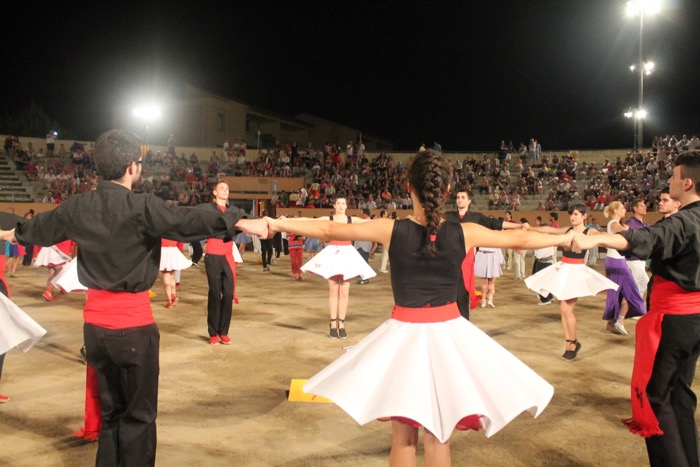
The Sardane is a traditional Catalan circle dance, believed to be of Greek origin, designed to bring whole villages out into the streets, and get them in party mood - a little like a more complicated version of the ’hokey cokey’in fact!

Music for the sardane is played by a cobla, a wind band with double bass consisting of 12 instruments played by 11 musicians. Four of these instruments (tenora, tible, flabiol and tamborí) are typical Catalan instruments along with the more traditional trumpet, trombone, fiscorn and double bass. The makeup of a cobla never varies.

For the Catalans, the Sardane is more than just a dance.

When the Spanish Republic was declared in 1931, Catalonia gained a degree of autonomy, but when the Second Spanish Republic collapsed in early 1939, General Francisco Franco, aided by Nazi Germany and Fascist Italy, declared a fascist government over which he ruled until 1975. He resented the Catalan national pride and desire for independence and considered it to be arrogant. He therefore enforced bans against certain aspects of Catalan culture, language and heritage, to force the Catalans to conform with the rest of Spain.
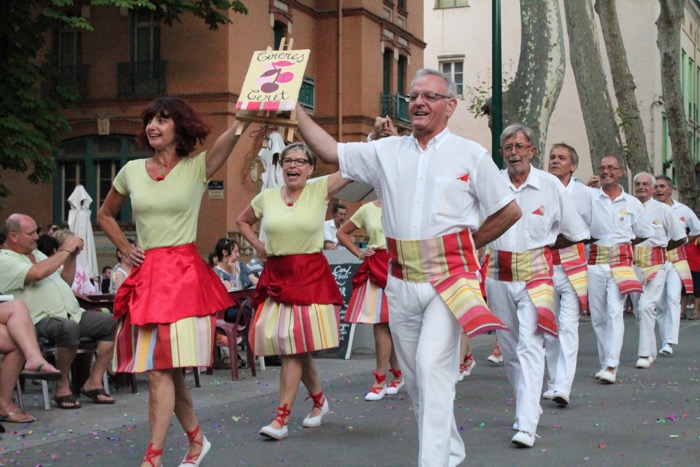
Not for the first time, the speaking of Catalan was banned. So was the Sardane. In a paranoid country, where walls had ears and spies were commonplace, Franco believed dancers were passing on coded messages with their feet! In fact, the banning served only to strengthen the national unity and fierce pride of the Catalans, which could not be extinguished, even under the rule of a dictator. The Sardane brought together all ages and classes, linked them to each other as they raised their heads and hands and declared their ’Catalanité’
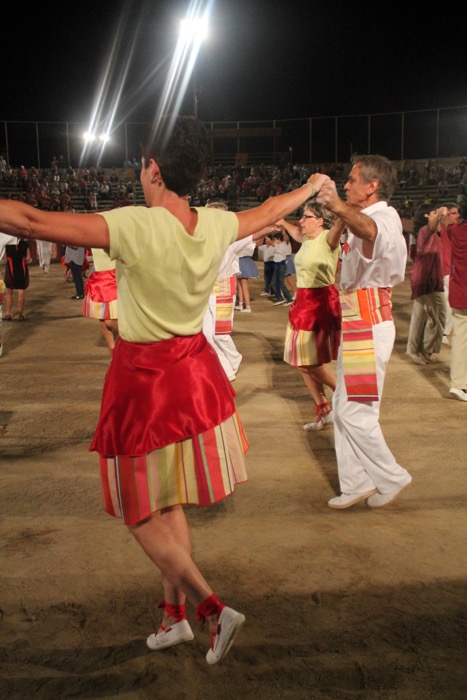
Today the Sardane is danced in villages and towns throughout Catalonia, by Catalan and non Catalan alike, and is a great way to make friends and take a little exercise at the same time. Join in the next time you see a Sardane starting up. The more the merrier!