
TGV: Perpignan – Barcelona in 50 mins
2013
November
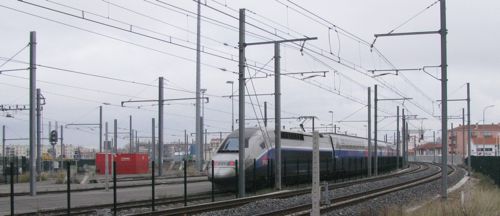
A long-awaited confirmation states that the TGV from Paris to Barcelona (expected to take 6 hrs 20 mins instead of the present 6hrs 40mins including the change at Figueras) is expected to be in service from 15 December. There will no longer be a change at Figuères, as was the case up till now. Tickets for the double-decker high-speed trains have gone on sale this week ahead of the service’s launch on December 15. There will initially be five services per day in each direction. Stations served include Perpignan, Narbonne, Montpellier, Nîmes and Valence in France and Girona and Figueres in Spain. The line will not be totally ‘à grande vitesse’ as the track is still not yet adapted in our little corner of the world! Journey time will be 1h20 between Perpignan and Barcelona with five ‘aller-retours’ between the two capitals. The earliest train will leave Barcelona at 9h with the latest return possibility from Perpigan at a very reasonable 22h allowing for great day trips for the Spanish. However, it will be a little more complicated the other way round unfortunately as the first train from Perpigan leaves at 10h and the last possible return from Barcelona leaves at 18h25, making a short day out in comparison. These timetables are expected to improve in 2014 |
2013November The start up date for the TGV Perpignan- Barcelona has been postponed at least until 2014 |
2013April Scheduled since early January to finally begin on April 28th 2013, the date of the first TGV to run from Perpignan to Barcelona has once again been postponed, this time until an unconfirmed May 26th. Reading down this page at the comedy of errors in the timing estimates which have stretched the construction of the Perpignan – Barcelona line over a period of eight years thus far, the postponement is hardly surprising. Also to blame is the lack of compatibility between the French TGV trains which the SNCF must run to Barcelona and Madrid which are different to current French trains as the alignment of the ERTMS European security system, which allows trains to run in any country without problems in computer language, is not yet fully developed in the TGV. A French train heading from Perpignan to Barcelona must actually, at times, limit its speed to 80 km / h for the safety of its passagers, defeating the object of the speedy TGV. |
2012October The latest announcement made this week by Enrique Verdeguer, president of the ‘société’, Adif, responsible for works on the TGV line give a final opening date of 31st July 2013. From that date, passengers will be able to travel from Perpignan station to Barcelona in the 50 minutes promised 8 years ago! |
2012April Too Good to be Vrai? If you were hoping to pop into Barcelona for tapas, then home for Coronation Street this year, you are going to be disappointed. Amidst loads of indignation, as the new government blamed the old government and vice versa, the Spanish authorities have admitted that the first train is unlikely to run before autumn 2013, causing a ’légère variation de calendrier’ ! |
| Une locomotive rencontre un TGV et lui demande: Ça fait longtemps que tu as arrêté de fumer? |
2012
March
Although nothing has as yet been announced officially, it would seem that the promised date of 2012 for the completion of the Figueres – Barcelona is unlikely to be met. The final stages of track, electricity and security system have not yet even been put up for tender, which should have taken place last October. Whilst the Spanish authorities still say the first train will run at the end of 2012, they are now admitting that a ‘légère variation de calendrier’ might be on the cards!
2011
October
The final tunnel, 3 km of underground route, dug up to 50 meters deep, has been completed on the Perpignan-Barcelona TGV line after two and a half years of digging under the city of Barcelona. All that now remains to be done is the laying of the rest of track between Figueres and Barcelona.
The tunnel joins the Montcada to Vallbona, in the north of Barcelona, and has been added to the first tunnel, completed in late July, joining the Sagrera station in the South to the central station of Sants.
At a cost of 127 million euros just for the digging, it is hoped that the rest of the work, rails, signal, electrics etc, will be finished for the projected opening at the end of next year, 2012.
May
The rails are now laid along the 36 km between between Figueres and Girona and the 27 tunnels and viaducts on that stretch of track are finished. Leaving from the temporary station of Figueres-Vilafant, heading south, the route includes a particularly impressive viaduct of 835 meters long, which spans the river Fluvià.
2010
November
The date set (below) for the first TGV to leave Perpignan for Figueres has yet again been put on hold. Various safety and technical exercises have still to been carried out and official authorisation has not yet been given for the trains to circulate on the track…..yet another setback in a catalogue of delays.
September
The first train TGV should leave Perpignan for Figueres on December 12th of this year, according to a spokesperson for the French company Eiffage. Two trains are expected to run per day.
The part of the line to open in December has been named “Paris-Figueres” and will be offically opened by the president of the SNCF, William Pepy.
Perpignan-Figueres is 44,4 km long, of which 24,6 km is in France and 19,8 km in Spain.
Perpignan – Barcelona will take 1 h 45, still a considerable time saver, but passengers will still need to alight and cross a platform at Figueres for a conventional train to Barcelona until the Barcelona-Perpignan line is complete, now predicted for 2013.
The price of the tickets is still unknown at the time of writing!
January
Guillaume Pepy of the SNCF confirmed this week that the TGV line between Perpignan and Figueres will be ready for use before the end of the year, and the Barcelona-Perpignan line will be open in 2012.
Long delays between Figueres and Barcelona are due to intractable geological problems at both Gerona – where two tunnels still need to be built avoiding or diverting three water courses – and Barcelona itself.
Passengers will take the TGV from Perpignan to Figueras (20 minutes) and cross a platform for a conventional train to Barcelona (1½ hrs). The change will be necessary because Spanish conventional lines have a wider gauge (1668-m) than the standard European one (1435-m).
18 trains will carry out 9 return journeys per day and at a reduced price compared to normal TGV tickets.
The remaining stretch from Montpellier to Perpignan should be finished 2021

2009
It seems that the section of the TGV line between Perpignan and Figueres will be ready for use, as originally contracted by builders TP Ferro, on the 17th February 2009. However, as the rest of the line remains unfinished, these 44,4 km of track are not expected to see TGV trains choo choo-ing along them before 2010, and some might say that the project, at a cost of 1,096 milliard (one thousand million) euros, is all a little overdue! At present, the track ends at Hostalet de Llers, just north of Nord de Figueres.
2008
August
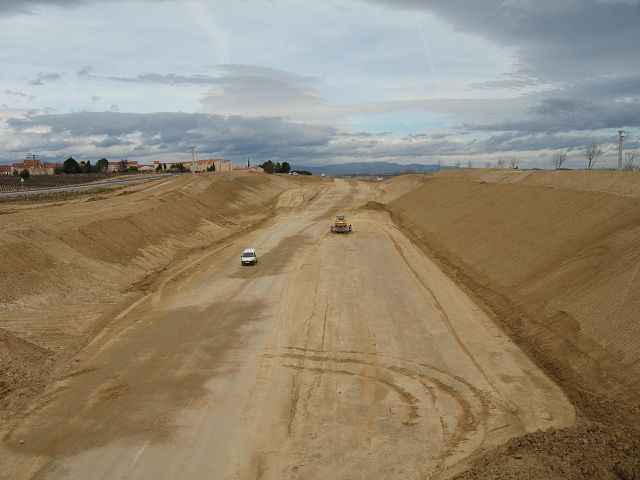
The Perpignan-Barcelona line continues to advance by 200 meters of track per day thanks to a German technique called « Rheda 2000 », used especially on high-speed routes and particularly suited for earthwork systems, tunnels, and bridges. Perpignan-Figueres is expected to be completed by late February 2009, and Figueres-Barcelone by 2012.

December
Following an announcement at the beginning of the month by José Montilla, president of the Generalitat de Catalunya, that the TGV Perpignan-Barcelone, was once again to be delayed, and not expected to be operational until 2015, this week bought assurances from French ambassador for Spain, Bruno Delaye, that it will in fact be functional by 2013. M. Delaye also confirmed that a reduced speed service would be available along the TGV line between Paris and Barcelona from 2009. At the same meeting, initial plans were unveiled for further TGV projects, one to pass through the Pays Basque, the other in the middle of the Pyrénées, joining the Hautes-Pyrénées in the north to Saragosse in the south. Let’s get Perpignan-Barcelone out of the way first eh guys?
2007

February
Two years away from the day in 2009 when the first train from Barcelona should enter Perpignan, the constant roadworks and land torn up has become so much a part of the scenery in the Pyrenees Orientales that one hardly even notices anymore. In particular, the 45km between Perpignan and Figueres have proved challenging – 8.3km straight through the Alberes – and not so cheap at a mere billion euros!
Although the offical ’début’ for the opening of the line is February 2009, the trains are expected to start running well before that to test them out for the general public.
The Route
Perpignan – Le Soler – Toulouges – Ponteilla – Villemolaque – Banyuls-des-Aspres – Tresserre – Montesquieu – Le Perthus – La Jonquera – L’Estrada – Bosquero – Biure – Llers – Figueres
The Facts
In order for the TGV to achieve speeds of 350 km/hour, it must run on a special line, an ’LGV’ (ligne à grande vitesse) which must be straighter than a normal train track.
taca, the mythological home of Ulysses, the greatest of Mediterranean voyagers, signifies a longing to return to roots. A new shop of the same name has recently opened in Collioure section of the TGV line going from Perpignan to Figueres (or rather Le Soler – Llers) will be known as the ’section internationale’ on this LGV (ligne à grande vitesse) and is being constructed by a private company TP Ferro, branch of the Spanish group ACS whilst the other part of the track is being built by the French Eiffage group, which also built the Eiffel Tower and the Millau viaduct.
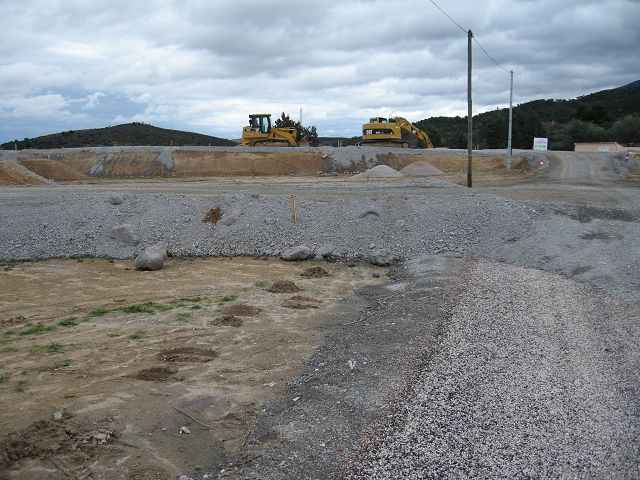
Along the 25km of the track which will be known as ’la plate-forme de France’ (Le Soler as far as the tunnel at Montesquieu), there will be 39 viaducts, tunnels, bridges…….. in other words, some kind of construction every 400m approximately.
Part of the contract states that all building work and subsequent construction should be landscaped and planted, so that the region does not continue to resemble a building site! Particular care has been taken in some areas to preserve the environment, for example in Toulouges where two large oaks have been replanted elsewhere, as they are home to large long-horned beetles.
Spanish trains drive on the right, French trains drive on the left! This has been solved by a ’saut de mouton’ (a sheep leap), one around Tresserre and another between Le soler and Toulouges, which allows the Spanish trains to leave the LGV and change to a French link line until the LGV is completed on to Montpellier.
On the French side of the Alberes tunnel, 1.4 million square metres of earth were moved and more than 200 tons of explosives used to break through 800,000 square metres of rock. The main road most effected by the TGV is the RD618 – Argeles to Le Boulou.

Digging is underway, roadside, just after village CatalanThe ’light at the end of the tunnel’ is expected by the end of this summer (2007) when the first of the ’tunneliers’ should break through the final rock layers of the Alberes into France. The two tunneliers, called Tramontane and Mistral, do not move quite as quickly as their namesakes!
Work has proceded more quickly on the Spanish side due to the fact that the Spanish are not terribly bothered to whom the land belongs – according to the DUP (Déclaration d’utililité publique), once it has been ’appropriated’ by the public services, Spanish land owners do not really have a say in the disposal of their land – wheras the French have to comply with permissions and land sale etc

June
It’s official! The expected date for completion of the TGV between Perpignan and Barcelona is now 2012, three years later than promised. It seems that the Spanish have decided to take the TGV UNDER Barcelona via a tunnel, rather than the original plan of taking it around the western side of the town. The present works are already proving a problem for the foundations of buildings such as Gaudi’s Sagrada Familia, so the decision has been made to build a tunnel which is expected to be safer, but will take a further three years to complete. Perpignan to Figueras will be completed by 2009
It is likely that the Spanish company, TP Ferro, responsible for completing the Spanish part of the Perpignan-Barcelona TGV line on or before 17th February 2009, will have to pay penalties to TGV backers for not respecting the time limits. They, in turn, will be compensated by the Spanish government. It had been expected that 34 passenger trains and 24 freight trains would travel the line daily
TGV Madrid- Barcelona
Only four years late, the TGV is expected to arrive in Barcelona from Madrid, by the end of this year, 2007. Passing through Tarragona, Lleida and Saragossa, the journey will take 2h30. The present main central station of Sants will be extended to include a bus station, fire station, new metro lines, hotel and shopping complex, offices….the whole at a cost of 220 million euros.)
2005
The creation of a new TGV (train à grande vitesse) line between Perpignan and Barcelona via le Perthus will make the journey so much faster and easier between France and Spain for both tourists and freight, with speeds of up to 186mph. At the moment, the journey time between the two towns is 2h45 – the expected time when the TGV is completed is 50 minutes! Work is well underway on the tunnel which will take the TGV across the Pyrenees and into Spain. Built in Germany and transported to La Jonquera in separate pieces, the tunnel drilling equipment (le tunnelier) which is to pierce the first of the two ‘tubes’ of the 8.2 kilometre tunnel should be ready for action in June. The ’tunnelier’, aptly named the Tramontana, weighs about 2,300 tons and is more than 150 metres long. At the moment, it is being assembled by a team of German engineers so if you travel along the motorway or the main road from Le Perthus to La Jonquera, look out for the large ‘building site’, home to the heavy equipment which will eventually create the LGV (ligne à grande vitesse) through the Albères Mountains.
On Friday 8th July 2005, the symbolic ’first rail’ was placed, signalling the sealing of the contract to take the TGV to Barcelona as well as the modernisation of Perpignan’s rail provision.
The provisional date for the first train from Perpignan to enter the station at Barcelona is 17th February, 2009.